Vero Beach, FL · Garage Door Service
West Vero Corridor homes date mostly to 1989, and that era's builder-grade springs and rollers are the calls we get most. We travel from Vero Beach, 6 miles out.
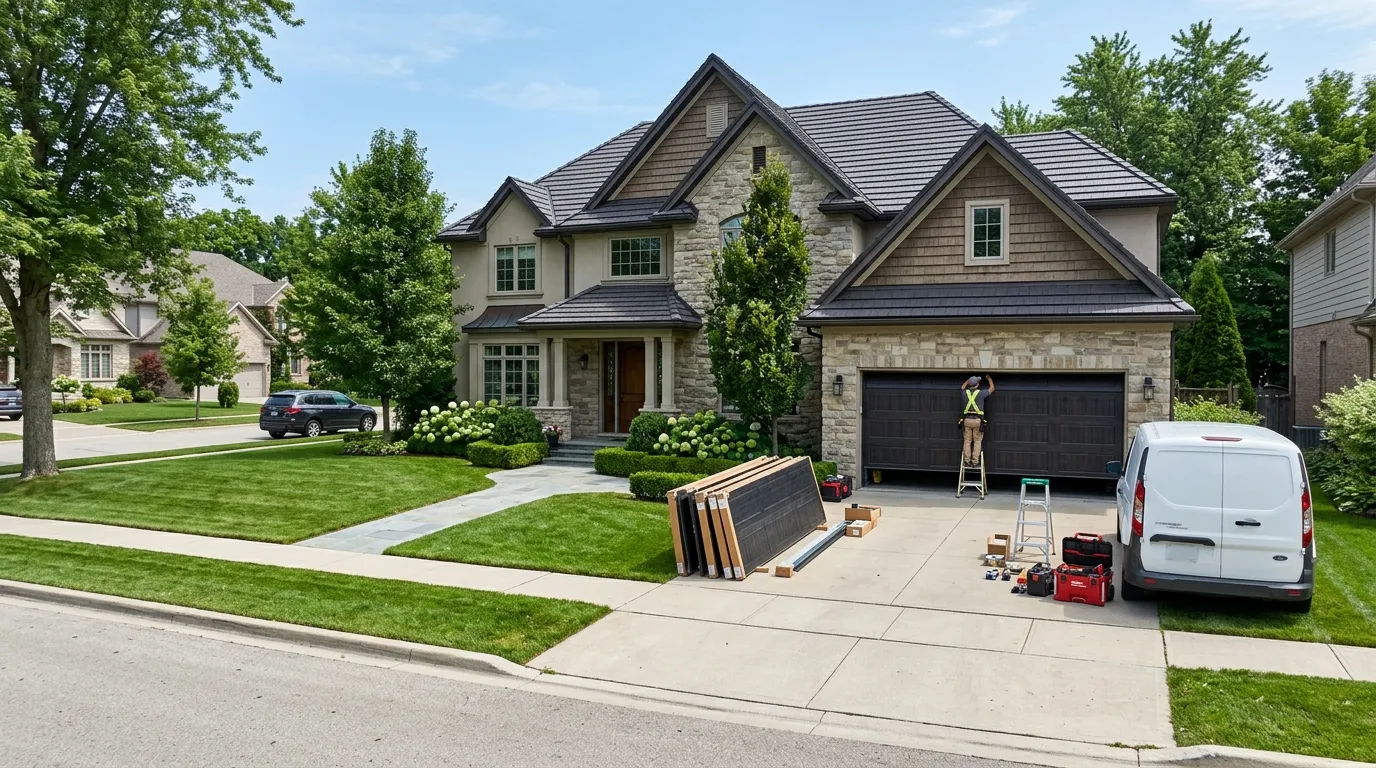
Calls from Indian River Shores tend to follow the age of the neighborhood. Most of the homes here went up around 1986, which puts the garage door hardware square in the middle of its expected working life for springs and rollers, but right at the point where openers start failing for good. We hear a lot about openers that grind, chain drives that have gone loud, and torsion springs that let go without warning on a door that otherwise looks fine. Across the wider service area of 33,258 households, Indian River Shores is one of the smaller pockets, with around 2,404 households, and a household income of $149,722 that's well above the area median of $65,809 - which shows up in the calls as more requests for a full opener upgrade instead of a patch repair, and less tolerance for waiting on a part. We're 4 miles out from our shop in Vero Beach, a short run whether the call is a stuck door before work or a spring that snapped on a Saturday.
A door built around 1986 is old enough that the original springs have likely been replaced once already, and the opener - if it's still the first one - is well past the point where parts are easy to find. The mild coastal climate here means you're not fighting frozen tracks or ice-locked openers like colder regions do, but salt air close to the water still works on unprotected hardware, and galvanized springs and exposed bolts show it first. What we mostly find on these calls is wear, not damage: a spring at the end of its cycle count, a roller that's worn oval instead of round, an opener logic board that's simply old. None of that is dramatic, but it's the kind of failure that happens without a leak or a storm to blame.
Indian River Shores sits about 4 miles from Vero Beach, and the housing stock reflects a build period concentrated around 1986 - later than some of the older sections closer to town, and fairly uniform street to street. That consistency is useful: a technician who's worked on a few doors in this pocket usually recognizes the hardware on the next one, same tracks, same spring sizing, same opener mounting. It's a smaller area than most of the ones we cover, with roughly 2,404 households, so the range of door ages and models is narrower than you'd see across the full service territory, which runs from Gifford and Winter Beach nearby out to farther points like Fellsmere and White City.
Given the age of the housing here, the most common jobs are spring replacement, opener swaps, and track or roller service on doors that have never had a real tune-up. We'll also get calls for panel damage from a backed-into door, which isn't tied to the age of the house at all. One honest limit: if an opener is old enough that the control board is discontinued, we won't hunt for a matching part that no longer exists - replacing the unit is usually faster and cheaper than chasing a part nobody stocks. For a house built in the mid-80s, that's often the more sensible call anyway, since a new opener runs quieter and safer than what it's replacing.
About 4 miles from our location in Vero Beach - close enough that we run out here regularly for both scheduled jobs and same-day calls.
Most homes here were built around 1986, which is fairly consistent street to street. That's newer than some older pockets in the service area but still old enough that original springs and openers are due for replacement.
The mild climate means no ice or freeze issues, but salt air near the water does work on exposed springs and bolts over time. It's a slower kind of wear than storm damage, but it adds up on original hardware.
No, we run out of Vero Beach and travel the roughly 4 miles into Indian River Shores for calls - there's no depot in the area itself.
Call now or request a free quote - same-day service on most repairs, upfront written pricing.
The call we get most from West Vero Corridor isn't a mystery once you know the housing stock. The median home here was built around 1989, which puts most garages on builder-grade steel doors with the springs and hinges that shipped standard in that era - not the heavier torsion setups you'd find on a house built in 2005. After three decades, those original extension springs are past their rated cycle count, the roller brackets have worked loose from the jamb, and the hinges show hairline cracks that don't show up until the panel folds.
West Vero Corridor sits inside the same broad build window as most of the service area (1969-2007, median 1987), but this pocket lands right on the late-80s side of that range, which is where builder-grade hardware was more common than the upgraded torsion systems used later. That's a different failure pattern than a 1970s door with its original single spring, and different again from a 2000s door with a heavier torsion bar carrying a bigger insulated panel. Know the build year, and you know which part is about to let go.
For a neighborhood built around 1989, the truck stock that matters is extension springs (still common on doors from that build window before torsion became standard), replacement rollers, hinge sets, and the cable and pulley hardware that extension-spring systems use instead of a torsion drum. We also carry standard torsion springs sized for single and double garage doors, since some West Vero Corridor houses were built or retrofitted with torsion systems later.
What we don't stock on the truck: oversized commercial door springs, and panels for doors that have been discontinued by their manufacturer - those get special-ordered once we've confirmed the make and size on site. If your door needs a discontinued panel, we'll tell you straight that a full door replacement is usually cheaper and faster than waiting on a custom-matched piece.
There's no branch or depot in West Vero Corridor - we run out of Vero Beach and cover this area as part of our regular route, about 6 miles out. Call, tell us what the door is doing (won't open, off track, spring snapped, opener clicking but not moving), and we'll get a truck scheduled. Having the door's age and whether it's original to the house helps us load the right spring and roller stock before we leave the shop.
Use the West Vero Corridor area page below to confirm we cover your street, or head to the main Vero Beach service page for the full list of repair and installation work we do.
We don't quote a fixed response window for West Vero Corridor because it depends on what's actually broken and whether the part is one we carry on the truck. A snapped extension spring or a roller replacement on a builder-grade door from the 1989 era is usually a same-visit fix once we're on site, since that hardware is common enough to stock. A cracked panel or a discontinued opener board is a different story - that part has to be ordered, and the door may sit non-operational, propped or manually locked, until it arrives.
Being honest about that lead time up front is better than promising a fix that depends on a part we don't have in hand. If your door is stuck open, we'll walk you through securing it safely while you wait, rather than leaving you guessing.
Rollers, hinges, and weatherstripping are reasonable DIY jobs if you're comfortable on a ladder and the door is disconnected from the opener while you work. Springs are not. Whether it's an extension spring stretched along the horizontal track or a torsion spring wound over the header, both store enough force to break fingers or worse if the winding cone slips. That's true on a 1989 door and it's true on a newer one - the age doesn't make it safer, it just changes which spring type you're dealing with.
If the door is off its track, sagging on one side, or the opener runs but the door doesn't move, stop and call. Those are usually cable, drum, or bracket problems that need the door supported correctly before anyone touches a spring or a track bolt.
Most homes in West Vero Corridor were built around 1989, so the majority of original garage doors and hardware date to the late 1980s. That means extension springs and builder-grade steel panels are far more common here than the heavier torsion systems used on newer construction.
No. We're based in Vero Beach and cover West Vero Corridor as part of our regular service route, about 6 miles from the shop. There's no separate depot or branch here, but the drive is part of our normal territory.
For West Vero Corridor's mostly late-1980s housing stock, we carry extension springs, rollers, hinge sets, and cable hardware sized for that era's builder-grade doors, along with standard torsion springs for houses that were built or retrofitted with torsion systems.
It depends on the part that failed and whether the panel itself is discontinued. A spring or roller job on a 1989-era door is usually a straightforward repair. If the panel is cracked and no longer made, replacement is often cheaper and faster than a special-order match.