Vero Beach, FL · Garage Door Service
Most Lakewood Park homes date to around 1988, so original springs, openers, and rollers are common failure points. We cover repairs here, traveling 8 miles from Vero Beach.
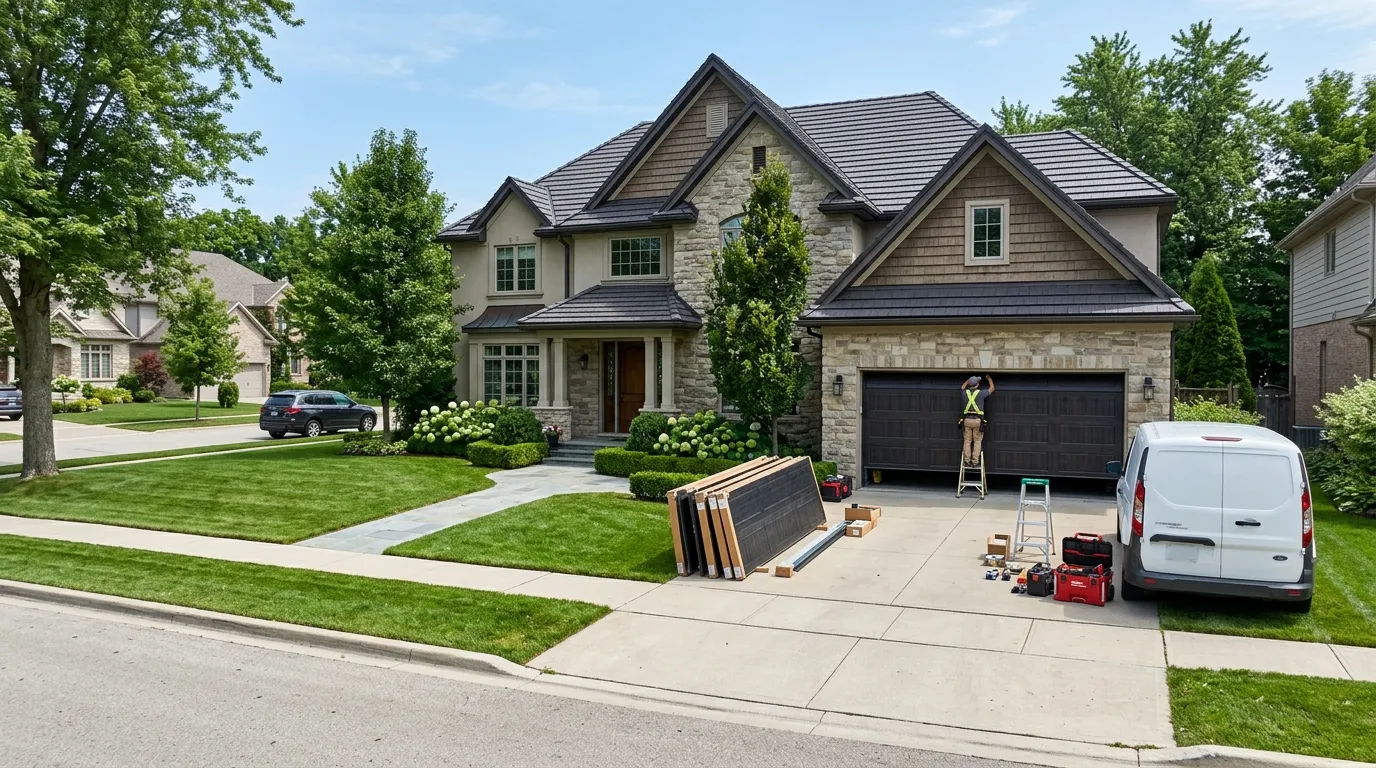
Calls from Indian River Shores tend to follow the age of the neighborhood. Most of the homes here went up around 1986, which puts the garage door hardware square in the middle of its expected working life for springs and rollers, but right at the point where openers start failing for good. We hear a lot about openers that grind, chain drives that have gone loud, and torsion springs that let go without warning on a door that otherwise looks fine. Across the wider service area of 33,258 households, Indian River Shores is one of the smaller pockets, with around 2,404 households, and a household income of $149,722 that's well above the area median of $65,809 - which shows up in the calls as more requests for a full opener upgrade instead of a patch repair, and less tolerance for waiting on a part. We're 4 miles out from our shop in Vero Beach, a short run whether the call is a stuck door before work or a spring that snapped on a Saturday.
A door built around 1986 is old enough that the original springs have likely been replaced once already, and the opener - if it's still the first one - is well past the point where parts are easy to find. The mild coastal climate here means you're not fighting frozen tracks or ice-locked openers like colder regions do, but salt air close to the water still works on unprotected hardware, and galvanized springs and exposed bolts show it first. What we mostly find on these calls is wear, not damage: a spring at the end of its cycle count, a roller that's worn oval instead of round, an opener logic board that's simply old. None of that is dramatic, but it's the kind of failure that happens without a leak or a storm to blame.
Indian River Shores sits about 4 miles from Vero Beach, and the housing stock reflects a build period concentrated around 1986 - later than some of the older sections closer to town, and fairly uniform street to street. That consistency is useful: a technician who's worked on a few doors in this pocket usually recognizes the hardware on the next one, same tracks, same spring sizing, same opener mounting. It's a smaller area than most of the ones we cover, with roughly 2,404 households, so the range of door ages and models is narrower than you'd see across the full service territory, which runs from Gifford and Winter Beach nearby out to farther points like Fellsmere and White City.
Given the age of the housing here, the most common jobs are spring replacement, opener swaps, and track or roller service on doors that have never had a real tune-up. We'll also get calls for panel damage from a backed-into door, which isn't tied to the age of the house at all. One honest limit: if an opener is old enough that the control board is discontinued, we won't hunt for a matching part that no longer exists - replacing the unit is usually faster and cheaper than chasing a part nobody stocks. For a house built in the mid-80s, that's often the more sensible call anyway, since a new opener runs quieter and safer than what it's replacing.
About 4 miles from our location in Vero Beach - close enough that we run out here regularly for both scheduled jobs and same-day calls.
Most homes here were built around 1986, which is fairly consistent street to street. That's newer than some older pockets in the service area but still old enough that original springs and openers are due for replacement.
The mild climate means no ice or freeze issues, but salt air near the water does work on exposed springs and bolts over time. It's a slower kind of wear than storm damage, but it adds up on original hardware.
No, we run out of Vero Beach and travel the roughly 4 miles into Indian River Shores for calls - there's no depot in the area itself.
Call now or request a free quote - same-day service on most repairs, upfront written pricing.
There's no branch or depot in Lakewood Park itself. We run out of Vero Beach, about 8 miles away, and take the call there before the truck heads out. When you call, tell us the door type (single or double), whether the opener is chain-drive or belt-drive if you know it, and what it's doing - won't open, won't close, stuck halfway, making noise. That gets us loading the right springs and cables before we leave rather than guessing on-site.
Most of what we're asked to fix in Lakewood Park traces back to the house's age. If you bought the place without touching the garage door, there's a decent chance nothing on it has been swapped since it was built. That matters for how fast we can turn the job around, because we bring parts sized for what a house from that era typically has, not whatever's newest on the shelf.
We book by phone, and we ask enough questions up front that the truck isn't empty-handed. A same-day slot depends on what's already on the schedule that day - we won't promise a window we can't hit.
Lakewood Park's housing stock runs close to 1988, right in the middle of the 1980s-90s wave that built out a lot of this service area. That means original torsion springs, original chain-drive openers, and original galvanized track that's never been swapped. Springs rated for a specific door weight in 1988 don't get gentler with age - they get one snap closer to done, usually on a cold morning or after the third cycle of the day.
The climate here is mild temperate, so we don't see the rust-through failures you'd get somewhere with real winters. What we do see: nylon rollers gone brittle and cracked, rubber weatherseal dried out and shrunk back from the frame, and openers with drive gears worn down from thirty-plus years of use with no lubrication ever added. None of that shows up as a dramatic failure - the door just gets slower, louder, and less reliable until one day it doesn't move.
The part that trips people up: a door that's been getting louder for months isn't a maintenance issue anymore by the time it seizes. It's usually a spring or cable that's a week or two from failing outright, and by then it's a same-visit fix, not a five-minute one.
Because the truck comes from Vero Beach, add the drive time to whatever's happening once we're on-site. Most single spring or cable jobs on a door this age are a same-visit repair - we carry stock sized for the torsion and extension spring setups common to 1980s and 90s builds, since that covers the bulk of what's out there in this service area.
Where it stretches out: if the opener itself is the original 1988 unit and the logic board or motor has failed rather than just a gear, we sometimes can't get that exact part same-day. Openers from that era aren't stocked the way current models are, and a specific control board can mean a special order. We'll tell you straight if that's the situation rather than have you wait around on a truck that isn't coming that day.
A panel or full door replacement is a different timeline than a repair - measuring, ordering, and installing a new door takes longer than swapping a spring, and we'll walk you through that separately if the door itself is done rather than just the hardware on it.
We don't have a set price to quote here without seeing the door - a broken spring, a bad cable, and a dead opener board are three different jobs with three different parts costs, and pretending otherwise would be a guess dressed up as a number. What we can tell you is what drives the cost on a house like the ones in Lakewood Park: whether the failed part is something we stock (springs, cables, rollers, standard hardware) or something that has to be sourced for an older opener.
Household income in this part of the service area runs a bit under the wider area average, and that's part of why we'll always tell you plainly when a repair isn't worth it against a replacement - a door that's failing on three fronts at once (spring, opener, and rotted panel) usually costs more to keep patching than to replace outright. We'd rather say that up front than run up a repair bill on a door that's on its way out anyway.
Get a number by having us look at it. Over the phone we can talk through likely ranges based on what you describe, but the firm price comes after the tech's eyes are on the actual hardware.
No - we run out of Vero Beach, about 8 miles away, and cover Lakewood Park from there. There's no local branch, so the price and timing account for that drive, but most repairs are still handled same day.
If your house dates to around 1988 like most of Lakewood Park, your opener might be original. Basic gear and sprocket repairs are usually straightforward, but a failed logic board on that old a unit can mean a special-order part rather than a same-day fix.
On a door this age, that's almost always brittle rollers, dried-out weatherseal, or a spring nearing the end of its life - none of which improve with rust in this mild climate, they just wear out mechanically. Loud usually means it's close to failing outright, not far from it.
Both, depending on condition. If the springs, opener, and panels are all failing around the same time, which happens on original 1988-era doors, replacement often costs less over time than repeated repairs. We'll say which one makes sense for your door specifically.