Vero Beach, FL · Garage Door Service
Panel replacement for Indian River Shores homes built around 1986 - matching builder-grade steel and aluminum sections, quoted and done from Vero Beach.
Calls from Indian River Shores tend to follow the age of the neighborhood. Most of the homes here went up around 1986, which puts the garage door hardware square in the middle of its expected working life for springs and rollers, but right at the point where openers start failing for good. We hear a lot about openers that grind, chain drives that have gone loud, and torsion springs that let go without warning on a door that otherwise looks fine. Across the wider service area of 33,258 households, Indian River Shores is one of the smaller pockets, with around 2,404 households, and a household income of $149,722 that's well above the area median of $65,809 - which shows up in the calls as more requests for a full opener upgrade instead of a patch repair, and less tolerance for waiting on a part. We're 4 miles out from our shop in Vero Beach, a short run whether the call is a stuck door before work or a spring that snapped on a Saturday.
A door built around 1986 is old enough that the original springs have likely been replaced once already, and the opener - if it's still the first one - is well past the point where parts are easy to find. The mild coastal climate here means you're not fighting frozen tracks or ice-locked openers like colder regions do, but salt air close to the water still works on unprotected hardware, and galvanized springs and exposed bolts show it first. What we mostly find on these calls is wear, not damage: a spring at the end of its cycle count, a roller that's worn oval instead of round, an opener logic board that's simply old. None of that is dramatic, but it's the kind of failure that happens without a leak or a storm to blame.
Indian River Shores sits about 4 miles from Vero Beach, and the housing stock reflects a build period concentrated around 1986 - later than some of the older sections closer to town, and fairly uniform street to street. That consistency is useful: a technician who's worked on a few doors in this pocket usually recognizes the hardware on the next one, same tracks, same spring sizing, same opener mounting. It's a smaller area than most of the ones we cover, with roughly 2,404 households, so the range of door ages and models is narrower than you'd see across the full service territory, which runs from Gifford and Winter Beach nearby out to farther points like Fellsmere and White City.
Given the age of the housing here, the most common jobs are spring replacement, opener swaps, and track or roller service on doors that have never had a real tune-up. We'll also get calls for panel damage from a backed-into door, which isn't tied to the age of the house at all. One honest limit: if an opener is old enough that the control board is discontinued, we won't hunt for a matching part that no longer exists - replacing the unit is usually faster and cheaper than chasing a part nobody stocks. For a house built in the mid-80s, that's often the more sensible call anyway, since a new opener runs quieter and safer than what it's replacing.
About 4 miles from our location in Vero Beach - close enough that we run out here regularly for both scheduled jobs and same-day calls.
Most homes here were built around 1986, which is fairly consistent street to street. That's newer than some older pockets in the service area but still old enough that original springs and openers are due for replacement.
The mild climate means no ice or freeze issues, but salt air near the water does work on exposed springs and bolts over time. It's a slower kind of wear than storm damage, but it adds up on original hardware.
No, we run out of Vero Beach and travel the roughly 4 miles into Indian River Shores for calls - there's no depot in the area itself.
Call now or request a free quote - same-day service on most repairs, upfront written pricing.
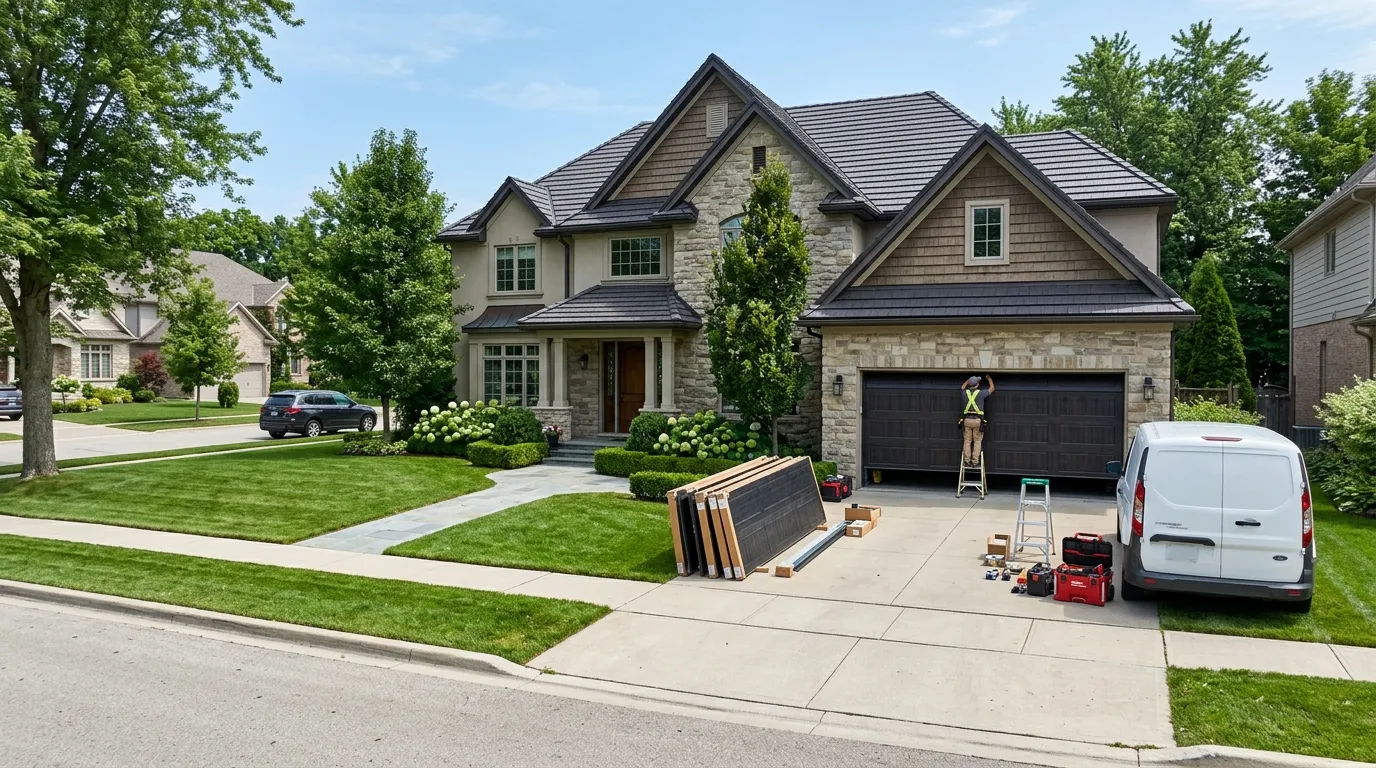
The call we get from this stretch of Indian River Shores is almost always one panel, not the whole door. A trash can clips the bottom section, a storm blows a chunk of debris into it, or the steel just gives out along a seam after enough years of the coastal air working on it. You'll see a crease across one panel, a rusted-through spot near the bottom rail, or a section that's bowed enough that the rollers bind when the door travels.
The reason it's usually one section and not the whole door: the housing stock here centers on 1986, right in the middle of the county's 1969-2007 build window. That means most doors are the same builder-grade steel or lightweight aluminum that went in standard on new construction through the 80s and 90s. That generation of door was built in individual bolted sections on a common track width, which is good news for a repair - one panel can often come off and go back on without touching the rest of the door. It's bad news when the exact profile isn't made anymore, which we'll get into below.
We don't guess at this over the phone. We look at the section, the hinge spacing, and the track before we say whether it's a panel swap or something bigger.
We run out of Vero Beach, about 4 miles from Indian River Shores, so there's no local branch sitting here and we're not going to promise a response window we don't have. What we can tell you is what actually eats the time on a panel job: it's rarely the labor, it's the part.
If your door still uses a section that a current manufacturer makes in a compatible size, we can often get you sorted in one visit once the part's in hand. If the door is an older or less common profile - which is more likely here given how many homes date to the mid-80s - we may need to order the panel, and that's a wait measured in days, not hours, depending on the supplier.
In the meantime, if the door is stuck and won't close, we can usually secure it so the opening isn't sitting wide open while you wait on the part. That's a stopgap, not a fix, and we'll say so plainly rather than let you think it's done.
We don't have a set number to hand you here - panel pricing depends on the door manufacturer, whether the section is still in production, and whether it's steel, aluminum, or an insulated composite. What we can tell you is what tends to move the number in this particular market.
Indian River Shores carries a median household income of $149,722, well above the wider service area's $65,809, and that shows up in what people ask for. More owners here want the replacement panel to actually match - same insulation value, same wood-grain or flush finish - rather than the cheapest steel section that fits the opening. That's a reasonable call on a door that's visible from the street, but it does mean sourcing takes a bit more care than grabbing a stock panel.
We'll give you the real number once we've seen the door and know whether the part's a catalog item or a special order. If you want the general pricing picture for panel work across the wider area, that's covered on our [Vero Beach panel replacement page](/garage-door-panel-replacement-vero-beach-fl), not here.
For doors from the 1980s-90s era - which covers most of what's on the ground in this part of the county - we stock common steel panel sections in the standard residential widths, along with basic hardware: hinges, rollers, and the fasteners those older sections use. Aluminum sections from the same period are less commonly stocked but easy enough to source.
What we don't keep on the truck is a wide range of insulated or composite panels in decorative finishes. Given the income profile here and the number of owners asking to match a nicer existing door, that's often a special-order item rather than something we swap same-day. We'd rather tell you that upfront than have you standing there expecting a shelf part.
If your door is a known national brand still in production, matching is usually straightforward. If it's an older or discontinued line, we check the section dimensions and hinge pattern against what current manufacturers make before we order anything, because a panel that's close but not exact will bind the door worse than the dent did.
The failure mode we see most on a door from this era is a panel that looks like a simple swap until we get the old section off and find the track or the hinges have worn to match it - meaning a new, straighter panel suddenly doesn't sit right against twenty-plus-year-old neighbors. At that point the honest move is sometimes to replace an adjacent panel too, or in worse cases recommend a full door rather than chase a mismatch section by section.
The other place it goes sideways: the exact panel profile is discontinued and the closest match is close enough to see, especially on a garage that's out front and visible. With 2,404 households in Indian River Shores, this isn't an area where people shrug that off. We'd rather flag a visible mismatch before we order the part than have you stuck with a door that reads wrong from the driveway.
We don't push a full replacement to avoid a harder repair. If a single-panel swap will hold and look right, that's what we quote.
Depends on whether the section is still made. Most 1980s-90s builder-grade steel panels have a modern equivalent we can order and fit to the existing track. If the profile's been discontinued, we'll tell you honestly whether a close match will look right or whether a full door is the better call.
We work out of Vero Beach, about 4 miles away, and don't run a branch in Indian River Shores itself, so we're not going to quote a response time we can't back up. Call and we'll give you a real estimate for that day based on our route.
If the old panel's track or hinges have worn unevenly over the years, a brand-new section can sit slightly differently than its faded, slightly warped neighbor. On a visible door, matching two sections sometimes looks and functions better than forcing one new panel next to old ones.
Not on the truck as a rule. Standard steel sections for 1980s-90s doors, yes. Insulated or decorative composite panels are usually a special order, which is common here given how many owners want the replacement to match a higher-end existing door.