Vero Beach, FL · Garage Door Service
Indian River Shores homes run 1980s-built openers and hardware on a $149,722 median income - here's what upkeep actually costs and when replacement wins.
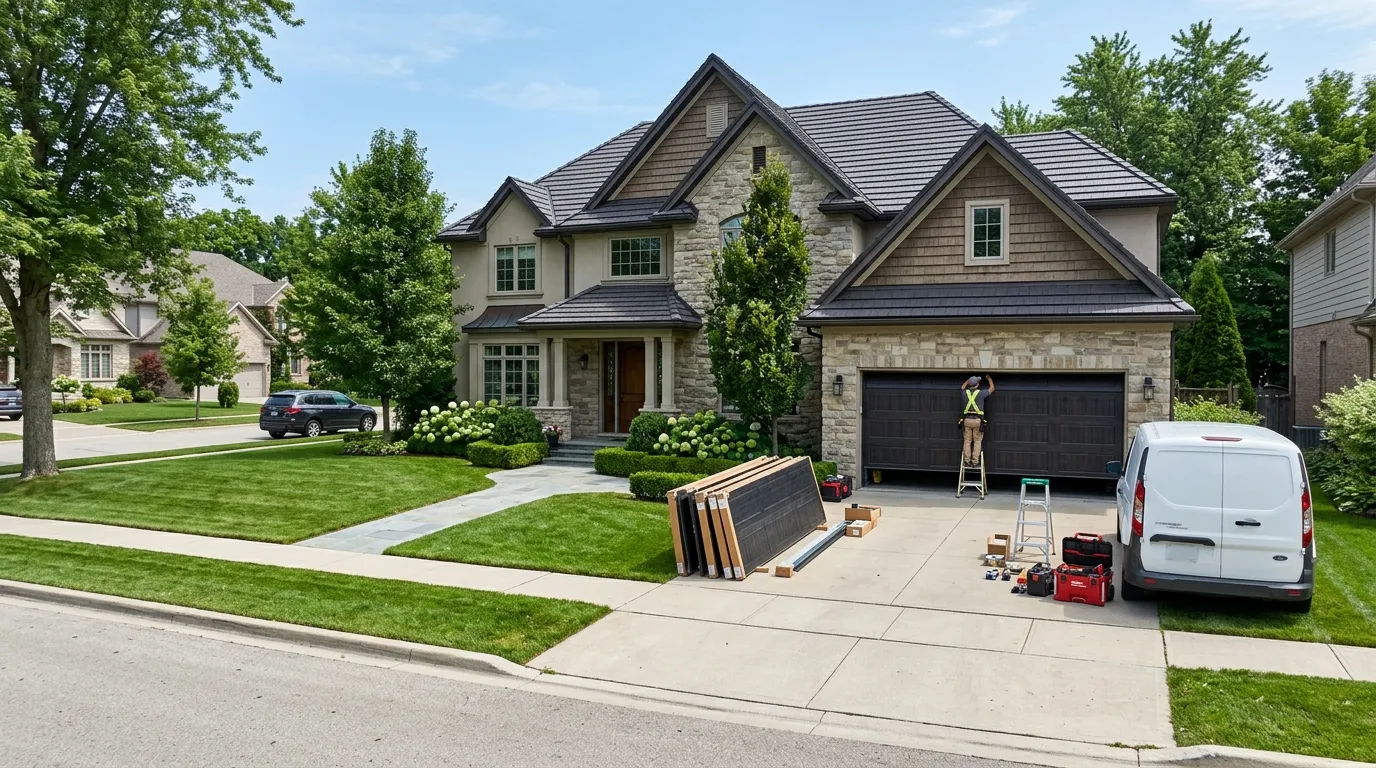
Calls from Indian River Shores tend to follow the age of the neighborhood. Most of the homes here went up around 1986, which puts the garage door hardware square in the middle of its expected working life for springs and rollers, but right at the point where openers start failing for good. We hear a lot about openers that grind, chain drives that have gone loud, and torsion springs that let go without warning on a door that otherwise looks fine. Across the wider service area of 33,258 households, Indian River Shores is one of the smaller pockets, with around 2,404 households, and a household income of $149,722 that's well above the area median of $65,809 - which shows up in the calls as more requests for a full opener upgrade instead of a patch repair, and less tolerance for waiting on a part. We're 4 miles out from our shop in Vero Beach, a short run whether the call is a stuck door before work or a spring that snapped on a Saturday.
A door built around 1986 is old enough that the original springs have likely been replaced once already, and the opener - if it's still the first one - is well past the point where parts are easy to find. The mild coastal climate here means you're not fighting frozen tracks or ice-locked openers like colder regions do, but salt air close to the water still works on unprotected hardware, and galvanized springs and exposed bolts show it first. What we mostly find on these calls is wear, not damage: a spring at the end of its cycle count, a roller that's worn oval instead of round, an opener logic board that's simply old. None of that is dramatic, but it's the kind of failure that happens without a leak or a storm to blame.
Indian River Shores sits about 4 miles from Vero Beach, and the housing stock reflects a build period concentrated around 1986 - later than some of the older sections closer to town, and fairly uniform street to street. That consistency is useful: a technician who's worked on a few doors in this pocket usually recognizes the hardware on the next one, same tracks, same spring sizing, same opener mounting. It's a smaller area than most of the ones we cover, with roughly 2,404 households, so the range of door ages and models is narrower than you'd see across the full service territory, which runs from Gifford and Winter Beach nearby out to farther points like Fellsmere and White City.
Given the age of the housing here, the most common jobs are spring replacement, opener swaps, and track or roller service on doors that have never had a real tune-up. We'll also get calls for panel damage from a backed-into door, which isn't tied to the age of the house at all. One honest limit: if an opener is old enough that the control board is discontinued, we won't hunt for a matching part that no longer exists - replacing the unit is usually faster and cheaper than chasing a part nobody stocks. For a house built in the mid-80s, that's often the more sensible call anyway, since a new opener runs quieter and safer than what it's replacing.
About 4 miles from our location in Vero Beach - close enough that we run out here regularly for both scheduled jobs and same-day calls.
Most homes here were built around 1986, which is fairly consistent street to street. That's newer than some older pockets in the service area but still old enough that original springs and openers are due for replacement.
The mild climate means no ice or freeze issues, but salt air near the water does work on exposed springs and bolts over time. It's a slower kind of wear than storm damage, but it adds up on original hardware.
No, we run out of Vero Beach and travel the roughly 4 miles into Indian River Shores for calls - there's no depot in the area itself.
Call now or request a free quote - same-day service on most repairs, upfront written pricing.
At a median household income of $149,722, Indian River Shores is not a town where people wait until a door falls off the track to call. Most of the calls we get from this side of the barrier island start small: a chain-drive opener that grinds before it lifts, a torsion spring that's lost its snap after thirty-some years of salt air and mild coastal humidity, rollers that have gone from smooth to gritty. The housing here runs a tight band around 1986, which puts a lot of these homes past the point where their original opener motor and spring set are original at all - they've likely been replaced once already, sometimes with mismatched parts. The symptom that matters isn't the noise itself, it's what the noise is telling you about a spring or bearing that's near the end of its cycle count. Catching that before it snaps is the whole point of a maintenance visit rather than an emergency call. We're not diagnosing over the phone - we look at the specific opener and hardware in front of us, because two houses built the same year can have very different setups depending on what got swapped out along the way.
We travel to Indian River Shores from Vero Beach, about 4 miles out, so there's a short window built into any visit before a tech is even in the driveway. For a maintenance call - lubrication, spring tension check, track alignment, hardware inspection - the door itself is rarely out of service for more than the time it takes to run through the checklist; nothing gets pulled apart unless we find something that needs it. If we do find a spring or cable close to failure, that's a different conversation, and we'll tell you on the spot rather than let you find out the day it breaks. We don't stock every part on the truck for every job, so if a specific opener board or an odd-length spring is needed, there can be a short wait on parts - that's the one honest limit here. A straightforward maintenance visit doesn't leave your car trapped inside; a full failure sometimes does, at least until the part is in hand.
With a median household income of $149,722 in Indian River Shores, the math on repair-versus-replace tends to land differently than it does elsewhere in the service area. A homeowner here is less likely to nurse a door along for another five years and more likely to want the job done right the first time - which usually means replacing worn springs and hardware in the same visit rather than patching one part now and another next year. Routine maintenance itself is the cheaper half of that equation: lubrication, tension checks, and hardware tightening cost far less than an emergency spring replacement, and they're what keeps you from needing the emergency call at all. We don't have a flat number to quote here without seeing the door - opener age, spring size, and what's already been swapped out all move the price. What we can say is that on a home built around 1986, a maintenance visit is almost always the cheaper path compared to waiting for something to give.
Homes built around 1986 in Indian River Shores commonly carry torsion springs sized for the standard steel doors of that era, along with openers that have likely been replaced at least once since - chain-drive units were still the default well into the 1990s. We carry common torsion spring sizes, rollers, cables, and hinges on the truck, along with standard opener drive components. What we don't always have on hand is a part for an opener that's already been swapped for something unusual, or hardware for a door that's been modified from its original spec - those sometimes mean a short parts order rather than a same-visit fix. Given the mild coastal climate here, corrosion on hinges and bottom brackets shows up more than in inland areas, and that's usually the first hardware we check on an older door.
The job goes sideways when a door that looks fine gets a quick lube job and nothing else, and six months later a spring lets go without warning. On a house built in the mid-1980s, that spring has had close to forty years to fatigue, even if it's never squeaked. It also goes sideways when someone tries to match new hardware to an opener that was already a mismatched replacement - the bracket doesn't line up, the sensor wiring is from a different generation of opener, and what should have been a maintenance visit turns into a half-day troubleshoot. We tell people straight when a door's hardware is past the point where maintenance makes sense and replacement is the better spend of their money - that call matters more on a house at this income level, where doing it right the first time is usually the cheaper long-run choice than a string of patch repairs.
For a door built around the mid-1980s to 1990s, once a year is reasonable if it's been running fine - lubrication, tension check, and a look at the hardware. If the opener or springs have already been replaced once, ask what generation of parts are on there now, since that changes what to watch for.
No. We're based in Vero Beach and drive out to Indian River Shores, about 4 miles away, for every job. There's no depot or drop-in location on the island side - all service is scheduled and dispatched from Vero Beach.
Possibly not. A lot of homes from that era have had at least one spring or opener replacement by now, especially given the coastal air here. We check the actual hardware on site rather than assume age from the build year alone.
On an older door, waiting usually means an emergency spring replacement instead of a planned visit, and that's rarely the cheaper route. Given the income level and home values in Indian River Shores, most owners we see here choose to fix things on their schedule rather than the door's.